
You passed your licensing exam. You filed your paperwork. You paid your fees. And then the government agency hands you one more requirement before they issue your license: a surety bond.
For millions of business owners and contractors across every industry in the United States, a license and permit bond is not optional — it is the final checkpoint between you and the legal right to operate. And yet most people applying for one have never heard the term before that moment. They do not know what it costs, how it works, or why it exists. This guide answers all of it.
What Is a License and Permit Bond?
A license and permit bond is a type of commercial surety bond required by a government agency — federal, state, or local — as a condition for granting a business license or permit to operate in a specific industry. By purchasing the bond, the business owner makes a legally binding promise to comply with all applicable laws, regulations, and professional standards governing their field. If they violate those obligations and cause harm, the affected party can file a claim against the bond.
License bonds and permit bonds are used interchangeably as terms. In practice, the distinction is subtle: a license bond is typically tied to an ongoing professional license (such as a contractor license bond or an auto dealer bond), while a permit bond is tied to a specific activity or project that requires a one-time work permit (such as an excavation permit bond or an encroachment permit bond). Many businesses require both.
Who Is Protected by a License and Permit Bond?
This is one of the most misunderstood points about license bonds — and it matters. The bond does not protect the business owner who purchases it. It protects the public: the consumers, clients, government agencies, and third parties who do business with or are affected by that licensed professional.
| Party | Role |
|---|---|
| Principal | The business or contractor who purchases the bond and makes the compliance promise |
| Obligee | The government agency or licensing authority that requires the bond and is protected |
| Surety | The bonding company that issues the bond and guarantees valid claims will be paid |
Unlike commercial general liability insurance — which protects your business from lawsuits — a license bond protects your customers from you. These are not interchangeable products. A business can be fully insured and still need a license bond. Both serve different purposes and meet different regulatory requirements.
Why Do Governments Require License and Permit Bonds?
The underlying purpose of a license bond is consumer protection at scale. When the government licenses a profession, it is certifying to the public that the licensee has met certain standards and can be trusted to perform a regulated activity. The bond backs that certification with money. If the licensed professional violates regulations, defrauds customers, fails to pay required taxes, or causes financial harm through negligence, the bond provides a direct financial remedy — without requiring the consumer to sue and win in court first.
License bonds also serve a secondary purpose: deterrence. Because the surety company must pay valid claims and then recover every dollar from the principal through the indemnity agreement, the bond creates a strong financial incentive for the business owner to stay compliant. A bond claim damages the principal’s ability to get future bonds, affects their credit profile, and in many jurisdictions triggers automatic license review or revocation.
What Do License and Permit Bonds Cover?
The coverage scope of a license bond corresponds directly to the regulations governing the licensed activity. Depending on the bond type and jurisdiction, a license and permit bond can provide financial recourse when a business fails to comply with the following.
| Trigger | Example |
|---|---|
| Violation of state or local laws | Auto dealer commits registration fraud; customers lose money |
| Building code violations | Contractor installs faulty wiring or inadequate ventilation |
| Failure to meet safety regulations | Electrician refuses to remedy unsafe wiring after completing a job |
| Failure to meet professional standards | Notary public fails to properly verify a signer’s identity |
| Failure to pay required taxes | Retailer fails to collect or remit sales tax on time |
| Third-party physical harm | Business owner’s sign over a public sidewalk injures a pedestrian |
That last category — third-party physical injury — is one that most people do not realize is covered by some license bond structures. When a licensing authority requires a business operating in a public space to post an indemnity guarantee for potential physical harm to bystanders, that guarantee functions as part of the license bond framework.
What License and Permit Bonds Do NOT Cover
License bonds have specific limits that business owners need to understand so they can secure the right additional coverage.
| Gap | Right Product |
|---|---|
| Employee theft from a client | Fidelity bond (also called a dishonesty bond) |
| Professional errors, mistakes, oversights | Professional liability / E&O insurance |
| Accidental damage to client property | General liability insurance |
| Work-related employee injuries | Workers’ compensation insurance |
| Business property damage or loss | Commercial property insurance |
A license bond covers regulatory compliance and consumer harm arising from violations of licensed duties. It does not function as a general insurance policy, and it does not protect the business owner’s own financial interests in the event of a loss.
Types of License and Permit Bonds
License and permit bonds cover nearly every regulated industry in every jurisdiction. Each bond type is specific to an industry and often to a particular state or municipality. There is no universal license bond — each one mirrors the regulatory requirements of the licensing authority that demands it.
Some of the most common types include contractor license bonds (required in most states for general contractors, electricians, plumbers, roofers, HVAC technicians, and specialty trades), auto dealer bonds (required in virtually every state for new and used vehicle dealers), mortgage broker bonds, notary bonds, freight broker bonds, insurance broker bonds, collection agency bonds, money transmitter bonds, payday loan bonds, health club bonds, travel agency bonds, and telemarketing bonds. Beyond these well-known types, license bonds exist for categories ranging from ignition interlock device installers and immigration consultants to waste haulers, pawnbrokers, talent agencies, patient trust fund managers, and pest control operators.
The bond required for a specific license is determined entirely by the obligee — the government agency issuing the license. The bond type, bond amount, and acceptable surety credentials are all set by the licensing authority, not by the bond applicant.
The Difference Between a License Bond and a Construction Bond
Contractors are among the most common purchasers of license and permit bonds, which creates a persistent source of confusion: contractor license bonds and construction contract bonds (performance bonds, payment bonds, bid bonds) are entirely separate instruments.
| Bond | Purpose | When Required |
|---|---|---|
| Contractor license bond | Guarantees the contractor will comply with licensing laws and regulations | To obtain and maintain a contractor’s license |
| Performance bond | Guarantees the contractor will complete a specific project per contract | When awarded a public or private construction contract |
| Payment bond | Guarantees subcontractors and suppliers will be paid | On public projects and some private contracts |
| Bid bond | Guarantees the contractor will enter into a contract if awarded the bid | When submitting a bid on a bonded project |
A contractor must qualify separately for each category. Having a contractor license bond does not substitute for a performance bond, and holding a performance bond program does not satisfy a license bond requirement. Many contractors need all four.
How Much Does a License and Permit Bond Cost?
License and permit bonds are among the least expensive bonds in the surety industry. Because they cover regulatory compliance rather than large construction contracts, the bond amounts tend to be smaller and the risk profile is lower.
| Credit Profile | Typical Premium Rate | Example: $10,000 Bond |
|---|---|---|
| Good credit (700+) | 1%–3% of bond amount | $100–$300 per year |
| Fair credit (650–699) | 3%–5% of bond amount | $300–$500 per year |
| Poor credit (below 650) | 5%–15% of bond amount | $500–$1,500 per year |
Many bonds at lower bond amounts — particularly notary bonds, small contractor license bonds, and similar low-risk bonds — are issued instantly at a flat 1% rate with no credit check required. For higher bond amounts or higher-risk industries, underwriting review applies and credit becomes a primary pricing factor.
Premium rates also depend on the bond amount required by the licensing authority, the type of industry (some are considered higher risk), the applicant’s business history and experience, and in some cases, financial statement documentation. Most license bonds are renewed annually, and some surety companies offer discounts for purchasing multiple years upfront.
What Happens if You Operate Without a Required License Bond?
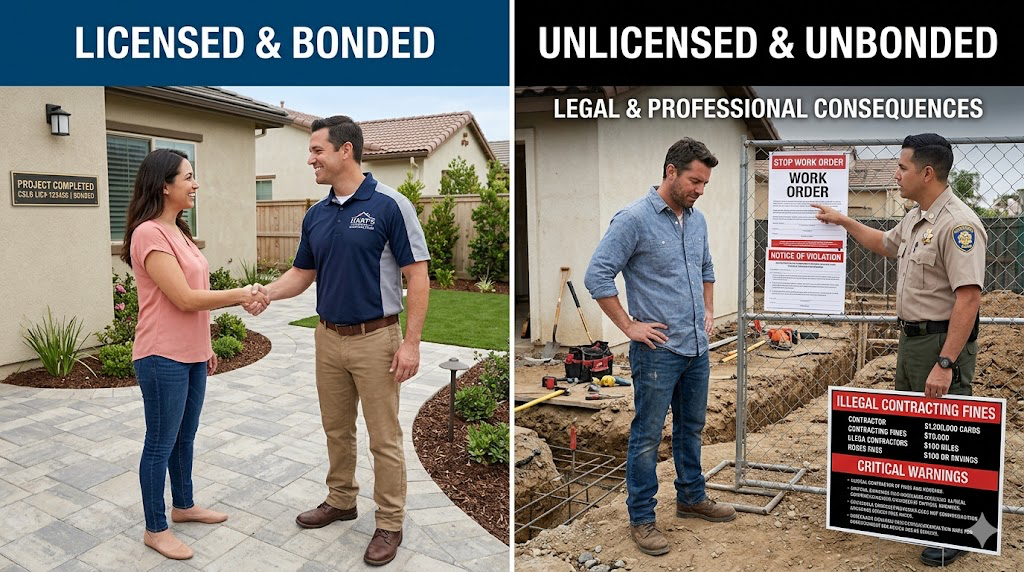
Operating a licensed business without the required bond is not simply a paperwork oversight — it carries real legal and financial consequences.
License revocation is the most immediate risk: many licensing authorities automatically revoke or suspend a license when the required bond lapses, expires, or is cancelled. Beyond license revocation, unlicensed and unbonded operation can expose a business to criminal charges in jurisdictions that make unlicensed contracting or professional practice a misdemeanor or felony. Civil liability exposure increases significantly — customers who suffer harm from an unbonded contractor have no bond to claim against and are more likely to pursue direct litigation. In some states, contracts executed by unlicensed contractors are void and unenforceable, meaning the contractor may not be able to collect payment even for legitimately completed work.
Bond termination is also worth understanding: a license or permit bond carries a term that corresponds to the license period. Whether a bond can be cancelled mid-term, and under what conditions, depends on whether termination is permitted by law, the ordinance requiring the bond, and the specific terms of the bond itself. Some bonds cannot be cancelled at all during the license period. Contractors and business owners should clarify termination conditions before purchasing.
How to Get a License and Permit Bond
Getting a license or permit bond is one of the most straightforward surety processes available. The steps are simple: Apply, Quote, Pay, and File. You identify the bond required by your licensing authority, submit your information (which for many smaller bonds is just a basic application with no credit check), receive a quote, pay the premium, and the bond is issued — sometimes within minutes. Swiftbonds specializes in helping business owners and contractors find and secure the exact license bond required by their state or municipality, including harder-to-place bonds for applicants with credit challenges or specialized industries. Whether you need a standard contractor license bond or a niche bond for a regulated profession, the process starts with a quick application.
Swiftbonds LLC
2025 Surety Bond Agency of the Year
4901 W. 136th Street
Leawood KS 66224
(913) 214-8344
https://swiftbonds.com/
What Happens When a Claim Is Filed Against a License Bond?
When a consumer, government agency, or other affected party believes the licensed business has violated the terms of its bond, they can file a claim with the surety company. The surety investigates the claim — reviewing evidence, interviewing relevant parties, and assessing whether the violation falls within the bond’s terms. If the claim is found valid, the surety pays the claimant up to the bond amount.
After paying, the surety seeks full reimbursement from the principal through the indemnity agreement. This is what distinguishes a bond from insurance: the business owner is ultimately responsible for every dollar paid out. A bond claim also triggers license review in most jurisdictions, and a history of valid bond claims makes future bonding more difficult and more expensive.
Claims against license bonds are relatively rare — most licensed businesses maintain compliance throughout the bond term without incident. However, if a dispute arises, the best first step is always to attempt direct resolution with the claimant before a formal claim is filed. Once a claim enters the surety’s hands, the process becomes formal and difficult to reverse.
Frequently Asked Questions
What is the difference between a license bond and a permit bond? The terms are used interchangeably in most contexts, but technically a license bond is tied to an ongoing professional license while a permit bond is tied to a specific work permit for a project or activity. A landscaper might carry a license bond to maintain their landscaping license and then need a separate permit bond each time a project requires disturbing the ground beyond a certain threshold or performing work in public right-of-way.
Is a contractor license bond the same as a contractor’s liability insurance? No. A contractor license bond protects the public from the contractor’s failure to comply with licensing laws and regulations. General liability insurance protects the contractor’s business from third-party claims of bodily injury or property damage. Both are typically required for licensed contractors, and neither substitutes for the other.
How do I find out what bond I need? The licensing authority issuing your license or permit will specify the bond type, the required bond amount, and the acceptable surety credentials. Start with the agency’s application materials or website. If the bond type is not clearly identified, a surety specialist can look up the requirements for your state, industry, and jurisdiction.
Can I get a license bond with a low credit score? Yes. Many license bonds are available to applicants with poor credit — the premium will be higher, reflecting the increased risk. Some bond types are issued with no credit check at all. For applicants who cannot qualify through standard surety markets, options including collateral arrangements and specialty surety programs are available. An experienced bond agent can identify the best path to approval regardless of credit history.
What happens to my license if my bond is cancelled or lapses? In most jurisdictions, a lapsed or cancelled bond results in automatic license suspension or revocation until a new bond is filed. The licensing authority typically requires the surety company to provide advance notice of cancellation — often 30 days — to give the licensee time to replace the bond. Business owners should monitor bond renewal dates carefully and act well before the expiration date to avoid any gap in coverage.
Do I need a new bond for each state I work in? In most cases, yes. License bonds are state-specific and often municipality-specific. A contractor license bond issued for California does not satisfy a license requirement in Nevada. Some national-level regulated industries — freight brokerage, for example — have federally required bonds that satisfy a single federal licensing requirement across all states. But for most licensed professions, separate bonds are required for each jurisdiction where you hold a license.
What is the bond amount, and who sets it? The bond amount — also called the penal sum — is the maximum the surety will pay on any claims against the bond during the bond term. It is set entirely by the licensing authority, not by the applicant or the surety company. Bond amounts vary widely by industry, state, and jurisdiction. A notary bond might be $10,000 in one state and $25,000 in another. An auto dealer bond might be $25,000 in one state and $100,000 in another. The bond amount does not represent the cost of the bond — it represents the maximum liability ceiling. Your actual cost is a small percentage of that amount.
Can multiple claims be filed against a single license bond? Yes. Multiple claims can be filed against a license bond during its term, but the total paid out cannot exceed the bond’s penal sum. If claims consume the full bond amount, the surety may require the principal to restore the bond to its full amount before continuing to operate. In some jurisdictions, multiple valid claims are treated as grounds for license revocation independent of the bond’s financial status.
Conclusion
A license and permit bond is not red tape. It is the financial commitment that converts a government license into something a customer can actually trust. It tells the market: this business has made a legally binding promise to follow the rules, and if they do not, there is money available to make things right. For the business owner, getting bonded is often the last step before opening the doors — and it is one of the least expensive forms of credentialing available. Understanding exactly what the bond covers, what it does not, and what happens if a claim is filed puts every licensed professional in a stronger position to operate with confidence.
When you are ready to get bonded, the process is simple: apply, get a quote, pay the premium, and file. The right surety partner makes it fast.
5 Interesting Things About License and Permit Bonds Not Found in the Top 10 Sites
- The first formalized license bond requirement in the United States dates to the late 1800s, when municipalities began requiring bonds from street vendors and peddlers who operated on public property. These early “peddler bonds” were designed to protect consumers from transient sellers who would take money and disappear — the direct ancestor of today’s transient merchant bonds and itinerant vendor bonds that still appear in municipal codes across the country.
- Some license bonds contain “discovery period” provisions that extend the right to file a claim beyond the bond’s expiration date — sometimes by one to three years after the bond term ends. This matters for clients who discover a violation after the bond has lapsed. Whether a discovery period applies depends on the state statute, the bond form, and the specific licensing ordinance — meaning two contractors in the same trade in adjacent states may have very different claim windows under their respective license bonds.
- The bond amount set by a licensing authority does not always reflect the actual financial risk to consumers in that industry. Bond amounts are often set by legislation that has not been updated in decades. In some states, auto dealer bonds are required at amounts that were established in the 1970s and have never been adjusted for inflation — meaning a consumer who suffers a $50,000 fraud loss may only be able to recover the full bond amount if the bond was set at $50,000 or higher. This gap between bond amounts and actual harm potential is a recurring topic of regulatory reform debate.
- In a small number of states, license bonds are structured as continuous bonds rather than annual bonds — meaning they remain in force indefinitely until cancelled, with premiums paid on a recurring basis. A continuous bond does not expire at the end of a license period but remains active until the surety or the principal files a cancellation notice. Contractors who hold continuous bonds may have bond obligations that outlast their active license by weeks or months depending on cancellation notice requirements.
- Cannabis-related businesses have created an entirely new frontier of license bond requirements since state-level legalization began in 2012. Cannabis dispensary bonds, cultivation facility bonds, and cannabis distribution bonds are now required in most states that have legalized recreational or medical cannabis — but surety companies are not federally authorized to bond activities that remain illegal under federal law. This creates a legal tension that most surety companies navigate by relying on state insurance regulation rather than federal authority, making cannabis bonds one of the most jurisdictionally complex categories in the license bond market.