You need a surety bond in Washington State. Maybe a court told you. Maybe the Department of Licensing requires it for your business license. Maybe you are handling an estate. Whatever the reason, one thing is clear: you need to get bonded quickly and correctly. This guide covers everything you need to know about purchasing surety bonds in Washington—the types, the costs, the requirements, and exactly how to get one.
What Is a Washington State Surety Bond?
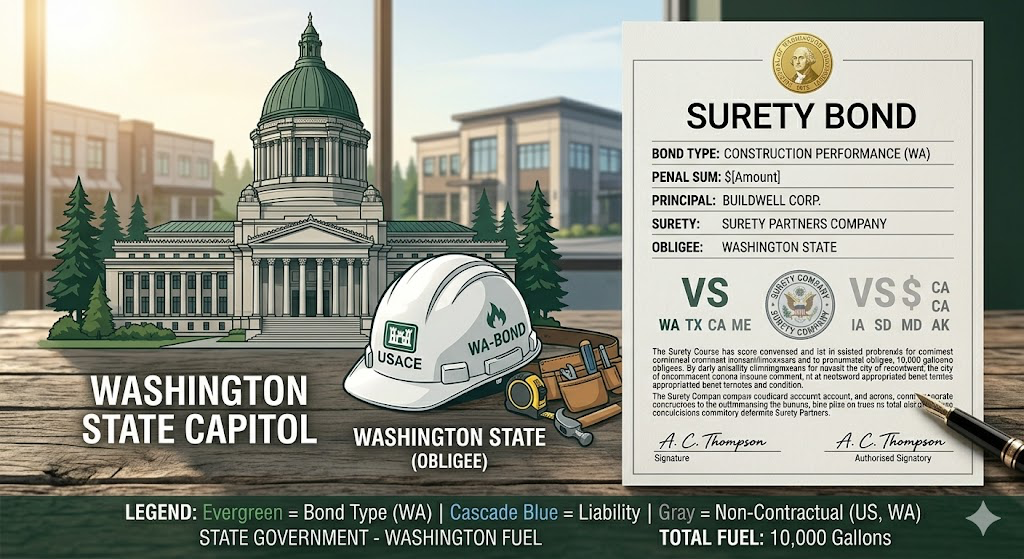
A surety bond is a three-party agreement that guarantees you will fulfill your legal or financial obligations . It is not insurance for you—it is protection for the court, the state, or the public .
The three parties are:
- Principal: You—the person or business who needs the bond
- Obligee: The Washington state agency, court, or municipality requiring the bond
- Surety: The company that issues the bond and guarantees your performance
If you fail to meet your obligations and a valid claim is filed against your bond, the surety pays the claimant up to the bond amount. You must then reimburse the surety in full .
Common Types of Washington Surety Bonds
Washington State requires surety bonds for many professions and situations. Below are the most common categories .
Court Bonds
Washington courts require surety bonds to protect one party when the other seeks a legal advantage . Common examples include:
| Bond Type | Purpose |
|---|---|
| Appeal (Supersedeas) Bond | Stay enforcement of a judgment while appealing |
| Replevin Bond | Recover personal property before a final ruling |
| Injunction Bond | Protect someone being restrained from an action |
| Attachment Bond | Plaintiff seeks to seize assets before judgment |
Court bonds typically cost 1% to 5% of the bond amount . The bond amount is often set by the court—for example, a Washington court might require a bond equal to 125% of a judgment for an appeal .
Probate and Fiduciary Bonds
Washington probate courts require a bond when someone is appointed to manage another person’s estate or financial affairs . These include:
- Executor/Administrator Bonds
- Guardianship Bonds
- Trustee Bonds
The bond guarantees that the fiduciary will act responsibly and follow state law . Bond amounts are based on the estate value, and premiums typically range from 0.5% to 1% of that amount .
License and Permit Bonds
Many Washington businesses must post a bond to operate legally . Below are the most common license bond requirements.
Contractor License Bonds
Under RCW 18.27.040, general and specialty contractors must obtain a continuous contractor surety bond .
| Contractor Type | Bond Amount | Starting Premium |
|---|---|---|
| General Contractor | $30,000 | $300/year |
| Specialty Contractor | $15,000 | $150/year |
| Electrical/Telecommunications | $4,000 | $100/year |
| Fire Sprinkler (Level 1, 2, I&T) | $6,000 | $100/year |
| Fire Sprinkler (Level 3, U) | $10,000 | $100/year |
| Farm Labor (1-10 employees) | $5,000 | $100/year |
| Farm Labor (11-50 employees) | $10,000 | $100/year |
| Farm Labor (51-100 employees) | $15,000 | $150/year |
| Farm Labor (100+ employees) | $20,000 | $200/year |
The bond guarantees that the contractor will pay everyone who performs labor, provides materials, or supplies equipment, and also guarantees payment of taxes to the state . Contractors must also carry general liability insurance of $200,000 in public liability and $50,000 property damage, or $250,000 combined single limit .

Motor Vehicle Dealer Bonds
Under RCW Title 46, motor vehicle businesses must file surety bonds with the Washington Department of Licensing .
| License Type | Bond Amount | Starting Premium |
|---|---|---|
| New or Used Vehicle Dealer | $30,000 | $196/year |
| Mobile Home Manufacturer | $40,000 | $262/year |
| Travel Trailer Manufacturer | $20,000 | $131/year |
| Wrecker | $1,000 | $100/year |
| Vessel Dealer | $5,000 | $100/year |
| Registered Tow Truck Operator | $5,000 | $100/year |
| Miscellaneous Vehicle Dealer | $5,000 | $100/year |
The bond protects consumers from financial loss if a motor vehicle business fails to operate according to Washington state law .
Collection Agency Bond
Under RCW 19.16.190, each collection agency applicant must file a $5,000 surety bond with the director . The bond is annually renewable on January first and runs to the state of Washington for the benefit of the state .
Consumer Loan License Bond
Under WAC 208-620-320, consumer loan license bond amounts are based on loan origination volume .
| Loan Origination Volume | Bond Amount |
|---|---|
| Zero to $20 million | $30,000 |
| $20 million to $40 million | $50,000 |
| $40 million to $50 million | $100,000 |
| $50 million and above | $150,000 |
If there is no prior year volume, the bond amount required at application is $30,000 .
Appraisal Management Company Bond
Under RCW 18.310.040, appraisal management companies must file a surety bond with a minimum penal sum of $100,000 . The bond runs to the state of Washington for the use and benefit of the state and any person who may have a cause of action against the obligor .
How Much Does a Washington Surety Bond Cost?
The cost of a surety bond is the premium you pay to the surety company—a small percentage of the total bond amount .
| Bond Type | Typical Premium Rate | Example Cost |
|---|---|---|
| Court bonds | 1% – 5% of bond amount | $100 – $500 per $10,000 |
| Probate bonds | 0.5% – 1% of estate value | $500 – $1,000 per $100,000 |
| License bonds | Flat rate or 1% – 5% | $100 – $500 per year |
| Contractor bonds | Starting at 1% | $150 – $300 per year |
Factors affecting your premium :
- Your personal credit score (primary factor)
- The type of bond required
- The bond amount
- Your business financials and experience
Example pricing for contractor bonds :
- General contractor ($30,000 bond): Starting at $300 per year (1%)
- Specialty contractor ($15,000 bond): Starting at $150 per year (1%)
- New or used vehicle dealer ($30,000 bond): Starting at $196 per year
- Wrecker, vessel dealer, tow truck operator ($1,000-$5,000 bonds): $100 per year flat rate
How to Purchase a Surety Bond in Washington State
The process follows four simple steps, and specialists like Swiftbonds have placed these bonds for Washington residents and businesses, working with A.M. Best A-rated sureties. Here is how it works :
- Identify Your Bond Type: Determine exactly which bond the court or agency requires. Check your court order, license application, or state regulation for the bond name and amount .
- Apply: Complete a surety bond application with your basic information, the required bond amount, and any supporting documents (court order, estate paperwork, license details) .
- Quote: Within hours, the surety returns a premium quote based on your credit profile and the bond type. Most license bonds have flat rates or simple percentage calculations .
- Pay and File: You pay the premium via credit card, ACH, or wire transfer. The surety issues the bond, and you file it with the court, probate court, or licensing board .
Swiftbonds LLC
2025 Surety Bond Agency of the Year
4901 W. 136th Street
Leawood KS 66224
(913) 214-8344
https://swiftbonds.com/
Washington-Specific Requirements
Continuous Bonds
Many Washington bonds are “continuous” bonds that remain in effect until canceled . For example, collection agency bonds are annually renewable on January first . Contractor bonds must be renewed every two years along with the contractor license .
Cancellation and Notice
Under Washington law, a surety may file notice of withdrawal on a bond. Liability of the former surety for all future acts of the licensee terminates upon filing a new bond or upon expiration of sixty days after filing notice of withdrawal .
Cash Deposits in Lieu of Bonds
Some Washington statutes allow cash deposits or other negotiable securities in lieu of surety bonds . For collection agencies, an applicant may deposit cash or other acceptable security with the director. The security is returned one year after the license expires or is revoked if no legal action has been instituted .
Local Washington Bond Requirements
Beyond state-level requirements, some Washington cities have their own bond requirements .
| City | Bond Type | Amount |
|---|---|---|
| Seattle | Side Sewer Contractor Bond | $30,000 |
| Redmond | Side Sewer Contractor Bond | $5,000 |
| Lakehaven Utility District | Sewer Service Contractor Bond | $10,000 |
| Tacoma | Maintenance and Monitoring Bond | Varies |
| Spokane | Temporary Certificate of Occupancy Bond | Varies |
Always check with your local city or county to confirm whether additional bonds are required for your specific business or project.
Frequently Asked Questions
Q: How do I know what bond I need?
Check your court order, license application, or state regulation. The document requiring the bond should specify the bond name, amount, and the obligee (the agency or court requiring it) .
Q: Can I get a surety bond with bad credit in Washington?
Yes. Many surety companies offer programs for applicants with credit challenges. However, your premium may be higher than someone with excellent credit .
Q: How fast can I get a Washington surety bond?
Most bonds can be issued within 24 hours of application. Some bonds—like auto dealer bonds—can be issued the same day if ordered by 4 PM CST .
Q: Do I need to renew my Washington surety bond?
Yes. Most Washington bonds are continuous and must be renewed annually or biennially. Contractor bonds must be renewed every two years along with the contractor license . Auto dealer bonds are issued for one year and must be renewed annually .
Q: What happens if a claim is filed against my bond?
The surety investigates the claim. If valid, the surety pays the claimant up to the bond amount. You must then reimburse the surety for the full amount paid, plus legal fees and costs .
Q: Can I use a cash deposit instead of a surety bond?
Some Washington statutes allow cash deposits in lieu of bonds. For collection agencies, a cash deposit is permitted under RCW 19.16.190 . Check with the specific agency requiring your bond.
Q: Where do I file my Washington surety bond?
The bond must be filed with the agency or court that required it. For license bonds, this is typically the Washington Department of Licensing, Department of Labor & Industries, or other state agency. For court bonds, file with the court clerk .
5 Interesting Things About Washington Surety Bonds Not in the Top 10 Sites
- Washington has a specific bond for “Registered Tow Truck Operators.” Under Title 46, tow truck operators who transport, import, impound, or store unauthorized vehicles must file a $5,000 surety bond—a requirement unique to Washington and a few other states .
- The $30,000 general contractor bond has been at this amount since 2004.Under RCW 18.27.040, the bond amount for general contractors has remained unchanged for over two decades, despite inflation and rising construction costs .
- Some Washington bonds allow a 25% premium reduction on renewal. For contractor bonds, some sureties offer a 25% reduction on the second-year premium if no claims were filed during the first year .
- Washington courts can require bonds equal to 125% of a judgment. For appeal bonds, Washington courts often require the bond amount to be 125% of the judgment to cover potential interest and costs during the appeal process .
- Out-of-state collection agencies may be exempt from bonding. Under RCW 19.16.190(7), an out-of-state collection agency need not fulfill Washington’s bonding requirements if it maintains an adequate bond or legal alternative in its home state .
Conclusion
Purchasing a surety bond in Washington State requires knowing exactly which bond you need, the required amount, and where to file it. The most common bonds include court bonds (1%-5% of bond amount), probate bonds (0.5%-1% of estate value), and license bonds such as contractor bonds ($30,000 for general contractors, starting at $300 per year), auto dealer bonds ($30,000, starting at $196 per year), and collection agency bonds ($5,000).
The process is straightforward: identify your bond type, apply with a surety company, receive your quote, pay the premium, and file the bond with the appropriate Washington court or agency. Most bonds can be issued within 24 hours, and many sureties offer programs for applicants with less-than-perfect credit.
Before purchasing, confirm your specific bond requirements with the Washington Department of Licensing, Department of Labor & Industries, or the court handling your case. The bond is not optional—it is a condition of doing business legally in Washington State.