
You want to work as a licensed contractor in Arizona. The desert sun is rising over another construction season, and projects are everywhere. But before you can hammer a single nail or sign a single contract, the Arizona Registrar of Contractors (ROC) requires one critical document: a contractor license bond. Without it, you cannot get licensed. Without a license, you cannot legally operate. This guide covers everything—the statutes, the bond amounts, the costs, the Recovery Fund, and exactly how to get bonded.
What Is an Arizona Contractor License Bond?
An Arizona contractor license bond is a type of surety bond required by the Arizona Registrar of Contractors (ROC) before a contractor can receive or renew a license . The bond guarantees that the contractor will comply with state laws, building codes, and contractual obligations . If a contractor fails to perform—through poor workmanship, contract violations, or failure to pay subcontractors—the bond provides financial protection to the injured party .
The bond is a three-party agreement between:
- Principal: The contractor who needs the bond and must perform their obligations
- Obligee: The Arizona Registrar of Contractors (ROC)
- Surety: The company that issues the bond and guarantees the contractor’s performance
If a claim is filed against the bond and the surety determines it is valid, the surety pays the claimant up to the bond amount. The contractor must then reimburse the surety in full .
Legal Authority: A.R.S. § 32-1152 and A.A.C. R4-9-112
The Arizona contractor license bond requirement is codified in Arizona Revised Statutes § 32-1152 . This statute establishes the bond requirements for all licensed contractors in Arizona.
Key provisions of A.R.S. § 32-1152:
- Before granting an original contractor’s license, the registrar shall require a surety bond or cash deposit
- No contractor’s license may be renewed unless the bond or cash deposit is in full force and effect
- Bond amounts are fixed by the registrar based on the volume of work and classification contemplated by the applicant
- The bond must be continuous in form
- A suit may not be commenced on the bond after the expiration of two years following the commission of the act or delivery of goods or services on which the suit is based
- The court may award reasonable attorney fees in a judgment against a contractor’s surety bond
The administrative details—including bond limits, applications, renewals, increases and decreases of bond amounts, and effective dates—are governed by Arizona Administrative Code R4-9-112 .
Who Needs an Arizona Contractor License Bond?
All licensed contractors in Arizona must maintain an active contractor license bond . This includes:
| License Type | Description |
|---|---|
| General Commercial Contractors (A and B classifications) | Commercial building and engineering contractors |
| Specialty Commercial Contractors (C classifications) | Electrical, plumbing, HVAC, and other specialty trades |
| General Residential Contractors (B and R classifications) | Residential building contractors |
| Specialty Residential Contractors (C and R classifications) | Residential specialty trades |
| Dual License Contractors | Contractors holding both commercial and residential licenses |
All license classifications must maintain a bond . Specialty contractors include trades such as electrical contractors, plumbing, HVAC, fire protection sprinkler system installers, and others as defined by the ROC .
Bond Amounts by License Type and Volume
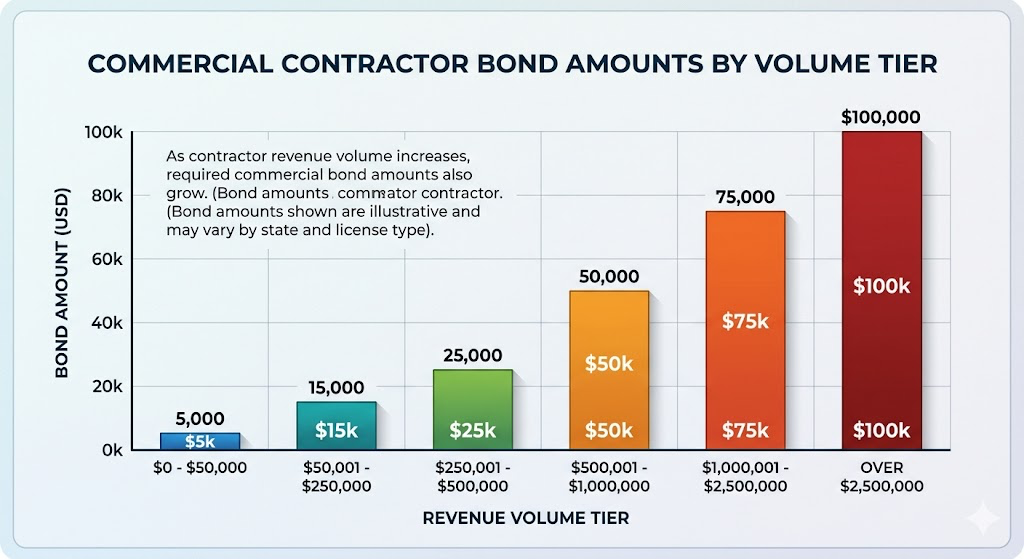
The required bond amount depends on your license classification and estimated annual volume of construction work .
Commercial General Contractors (A and B classifications)
| Estimated Annual Volume | Bond Amount |
|---|---|
| Less than $150,000 | $5,000 |
| $150,000 – $500,000 | $15,000 |
| $500,000 – $1,000,000 | $25,000 |
| $1,000,000 – $5,000,000 | $50,000 |
| $5,000,000 – $10,000,000 | $75,000 |
| $10,000,000 or more | $100,000 |
Commercial Specialty Contractors (C classifications)
| Estimated Annual Volume | Bond Amount |
|---|---|
| Less than $150,000 | $2,500 |
| $150,000 – $500,000 | $7,000 |
| $500,000 – $1,000,000 | $17,500 |
| $1,000,000 – $5,000,000 | $25,000 |
| $5,000,000 – $10,000,000 | $37,500 |
| $10,000,000 or more | $50,000 |
General Residential Contractors
| Estimated Annual Volume | Bond Amount |
|---|---|
| Less than $750,000 | $9,000 |
| $750,000 or more | $15,000 |
Specialty Residential Contractors
| Estimated Annual Volume | Bond Amount |
|---|---|
| Less than $375,000 | $4,250 |
| $375,000 or more | $7,500 |
Dual License Contractors
Dual license holders (contractors performing both commercial and residential work) must post a bond that combines the amounts required for each classification .
For General Dual License Contractors: The bond amount is determined under subsection (A)(3) for residential and subsection (A)(1) for commercial . The bond issuer must separately specify on the bond the amounts applicable to each classification .
For Specialty Dual License Contractors: The bond amount is determined under subsection (A)(4) for residential and subsection (A)(2) for commercial .
Residential Recovery Fund: An Additional Requirement for Residential Contractors
Dual licensed contractors and residential contractors have an additional requirement under A.R.S. § 32-1152(C) . They must either:
- Furnish an additional surety bond or cash deposit of $200,000 solely for actual damages suffered by claimants as described in A.R.S. § 32-1132, or
- Participate in the residential contractors’ recovery fund and pay the assessment prescribed by A.R.S. § 32-1126(G)
The vast majority of residential contractors choose to participate in the Recovery Fund rather than post the additional $200,000 bond, because the contribution cannot exceed $600 per year .
What Is the Recovery Fund?
The Recovery Fund is a form of financial protection provided by licensed Arizona residential contractors to residential homeowners . The fund is governed by statute and available only to claimants who own and occupy, or intend to occupy, residential property .
The Recovery Fund does NOT accept claims from: suppliers, subcontractors, laborers, or other commercial entities .
Who Is Eligible to File a Recovery Fund Claim?
To be deemed eligible for recovery from the Fund, a claimant must demonstrate :
- The contractor’s residential or dual license was suspended or revoked as a direct result of a formal complaint filed by the claimant (this requirement does not apply to civil claims)
- Prior to filing a claim with the Recovery Fund, the claimant must first have filed a claim against the contractor’s license bond and received a final determination
- The contractor must be a licensed residential contractor
- The claimant must be an owner-occupant of residential property, an LLC where all members occupy the property, or other qualifying party
- The contractor must have been appropriately licensed at the time the contract was signed, first payment was made, or work first commenced
- The claim must be filed within the relevant two-year statute of limitations
What the Bond Protects
Under A.R.S. § 32-1152(E), the bond or deposit protects different parties depending on the license type .
For Commercial License Bonds
The bond is for the benefit of and subject to claims by :
- A licensee under this chapter
- A lessee, owner, or co-owner of nonresidential real property
- Any person who has a direct contract with the licensee and is damaged by failure to build or improve in compliance with building codes or standards approved by the registrar
For Residential License Bonds
The bond is for the benefit of and subject to claims by :
- Any person furnishing labor, materials, or construction equipment used in direct performance of a construction contract involving a residential structure
- Claimants as described in A.R.S. § 32-1132
For Recovery Fund Bonds
The bond is for the benefit of and subject to claims only by claimants as described in A.R.S. § 32-1132 .
Bond Duration and Renewal
Continuous Bond Requirement
The bond must be continuous, meaning there is no termination date on the bond . You may be required to pay premiums to the insurance company periodically to keep the bond in force .
Cancellation
The bonding company has the right to cancel the bond but must send a notice to you and the Arizona Registrar of Contractors thirty days prior to the cancellation date . If this occurs, you will need to replace the bond or your license will be suspended .
Effective Date
Surety bonds or cash deposits shall not become effective until filed with the Registrar’s office . If the effective date shown on the bond is after the date of filing with the Registrar, then that date shown on the bond shall be the controlling date for when the bond becomes effective .
Increasing or Decreasing Bond Amounts
The amount of the contractor’s license bond may be increased at any time . However, a surety bond or cash deposit cannot be decreased except at the time of renewal for the ensuing fiscal year .
Suit Limitations
A suit may not be commenced on the bond or for satisfaction from the cash deposit after the expiration of two years following the commission of the act or delivery of goods or rendering of services on which the suit is based .
Cash Deposits as an Alternative to Surety Bonds
Under A.R.S. § 32-1152(D), a contractor may establish a cash deposit in the amount of the bond with the state treasurer in accordance with rules adopted by the registrar .
Key points about cash deposits:
- Cash deposit monies are deposited in the contractors’ cash bond fund
- The state treasurer invests monies in the fund, and earnings are credited to the state general fund
- Cash deposits may be withdrawn, if there are no outstanding claims against them, two years after the termination of the license
- The cash deposit may be withdrawn two years after the filing of a commercial surety bond as a replacement to the cash deposit
How Much Does an Arizona Contractor License Bond Cost?
The cost of a contractor license bond is the premium you pay to the surety company—a small percentage of the total bond amount .
Premium Rates by Credit Profile
| Credit Profile | Typical Premium Rate |
|---|---|
| Excellent credit | 1% – 3% |
| Good credit | 3% – 6% |
| Moderate credit | 5% – 10% |
| Challenged credit | 10% – 15%+ |
Example Premium Costs
| Bond Amount | Starting Premium (Good Credit) |
|---|---|
| $5,000 | $100 |
| $15,000 | $150 |
| $25,000 | $250 |
| $50,000 | $500 |
| $75,000 | $750 |
| $100,000 | $1,000 |
Important: Surety bonds in Arizona are typically issued for a two-year term, so the premium you pay covers the full two-year period .
Factors Affecting Your Premium
- Personal and business credit score (primary factor)
- Required bond amount (higher amounts may have lower percentage rates)
- Contractor experience and financial history
- License type and work history
- Prior claims (if any)
Even if you have bad credit, you can still get bonded through specialty underwriting programs .
How to Get an Arizona Contractor License Bond
The process follows four simple steps, and specialists like Swiftbonds have placed these bonds for contractors across Arizona, working with A.M. Best A-rated sureties. Here is how it works:
- Apply: Complete a surety bond application with your business information, credit details, estimated annual volume, and license classification.
- Quote: Within hours, the surety returns a premium quote based on your credit profile and the required bond amount.
- Pay: You pay the premium via credit card, ACH, or wire transfer.
- File: The surety issues the bond. If the surety is associated with the ROC’s online portal, they can upload your bond directly . Otherwise, you file the bond with the Arizona Registrar of Contractors.
Swiftbonds LLC
2024 Surety Bond Provider of the Year
4901 W. 136th Street
Leawood KS 66224
(913) 214-8344
https://swiftbonds.com/
How to File the Bond With the Arizona ROC
To activate your license, the bond must :
- Match your legal business name as registered with the ROC
- Match your exact license classification (e.g., CR-11, B-1, A-General)
- Include the bond amount assigned by the ROC
- Be signed by both the principal and surety
- Be submitted electronically or by mail to the ROC
One of the many benefits of using the Registrar of Contractors’ Online Customer Service Portal is that if a surety company is associated with the bond portal, it can conveniently upload your bond directly to the portal, which helps to limit mistakes .
Frequently Asked Questions
Q: Do all Arizona contractors need a bond?
Yes. All licensed contractors must carry a bond under Arizona state law .
Q: Who assigns the bond amount?
The Arizona Registrar of Contractors assigns the amount based on project volume and license category .
Q: Does this bond replace liability insurance?
No. This bond protects consumers and the state, not the contractor .
Q: How long is a bond valid?
The bond must be continuous—there is no termination date on the bond. You pay premiums periodically to keep it in force .
Q: What happens if a claim is filed against my bond?
The surety investigates. If valid, the surety pays the claimant up to the bond amount. You must then reimburse the surety in full, plus legal fees and costs .
Q: Can the bond amount be increased?
Yes, the bond amount may be increased at any time. However, a bond cannot be decreased except at license renewal .
Q: What is the statute of limitations for claims against a contractor bond in Arizona?
A suit may not be commenced on the bond after the expiration of two years following the commission of the act or delivery of goods or services on which the suit is based .
Q: Can I use a cash deposit instead of a surety bond?
Yes. Under A.R.S. § 32-1152(D), you may establish a cash deposit with the state treasurer .
Q: What if I upgrade my license classification?
Your required bond amount may increase. You will need to obtain an additional bond or increase your existing bond .
5 Interesting Things About Arizona Contractor License Bonds Not in the Top 10 Sites
- The bond amount for general commercial contractors used to have a zero minimum. Under earlier versions of A.R.S. § 32-1152, the bond amount for commercial contractors was set by the registrar with no statutory minimum. The current schedule with specific dollar amounts was established through subsequent amendments .
- A gross underestimate of volume is a material misrepresentation. Under Arizona Administrative Code R4-9-112(C), the Registrar of Contractors considers a gross underestimate knowingly made by a licensee to be a material misrepresentation, which can subject the licensee to suspension or revocation of license .
- The Recovery Fund does not require a contractor to have a suspended license for civil claims. While administrative Recovery Fund claims require the contractor’s license to have been suspended or revoked, civil Recovery Fund claims filed pursuant to A.R.S. § 32-1133 do not have this requirement .
- Cash deposit monies earn interest for the state, not the contractor. Under A.R.S. § 32-1152(D), cash bond monies are deposited in the contractors’ cash bond fund, and monies earned from investment are credited to the state general fund—not returned to the contractor .
- The ROC provides an online bond portal for surety companies. If a surety company is associated with the ROC’s bond portal, it can conveniently upload your bond directly to the portal, which helps to limit mistakes. This is one of the many benefits of using the Registrar of Contractors’ Online Customer Service Portal .
Conclusion
An Arizona contractor license bond is a mandatory requirement for all licensed contractors in the state, governed by A.R.S. § 32-1152 and A.A.C. R4-9-112 . Bond amounts range from $2,500 for specialty commercial contractors with low volume to $100,000 for general commercial contractors with high volume .
Residential and dual license contractors have an additional requirement: either a $200,000 consumer protection bond or participation in the Residential Contractors’ Recovery Fund . The vast majority choose to participate in the Recovery Fund, as the annual contribution cannot exceed $600 .
The bond protects consumers, property owners, subcontractors, and suppliers from financial losses caused by contractor misconduct, poor workmanship, contract violations, or failure to pay . A suit on the bond must be brought within two years of the act or delivery of goods or services .
Premiums typically range from 1% to 15% of the bond amount depending on credit, with starting premiums as low as $100 for a $5,000 bond . The bond must be continuous and filed with the ROC before a license can be issued or renewed .
Before applying for any Arizona contractor license bond, confirm your required bond amount with the Registrar of Contractors based on your license classification and estimated annual volume. The bond is not optional—it is a condition of doing business legally in Arizona.
Leave a Reply