
You bought a used RV from a private seller. Cash changed hands. You have the keys, the bill of sale, and big travel plans. But the seller lost the title years ago, and now you have no way to prove ownership. Without a title, you cannot register it, insure it, or sell it. The solution? A bonded title. This guide explains exactly how to get a bonded title for your RV, step by step.
What Is a Bonded Title for an RV?
A bonded title (also called a certificate of title bond or lost title bond) is a legal document that proves vehicle ownership when the original title is missing, lost, stolen, or cannot be transferred . It is backed by a surety bond that protects the state, previous owners, and any lienholders for a set period—typically three years .
If a previous owner or lienholder comes forward during that period and proves they have a valid claim to the RV, they can recover against the bond. After the bond period expires with no claims, you can convert the bonded title to a standard, clear title .
The bond is a three-party agreement between:
- Principal: You—the RV owner applying for the bonded title
- Obligee: Your state’s DMV or equivalent agency
- Surety: The company that issues the bond and backs the guarantee
When Do You Need a Bonded Title for an RV?
A bonded title is typically required when:
| Scenario | Description |
|---|---|
| Lost or missing title | You purchased an RV without a title, or the seller cannot provide one |
| Damaged or illegible title | The existing title is physically damaged or unreadable |
| Title with errors | The title has incorrect information about the owner, VIN, or other details |
| Inherited RV | You inherited an RV that did not have a title or the title cannot be found |
| Abandoned or unclaimed RV | You came into possession of an RV that appears abandoned |
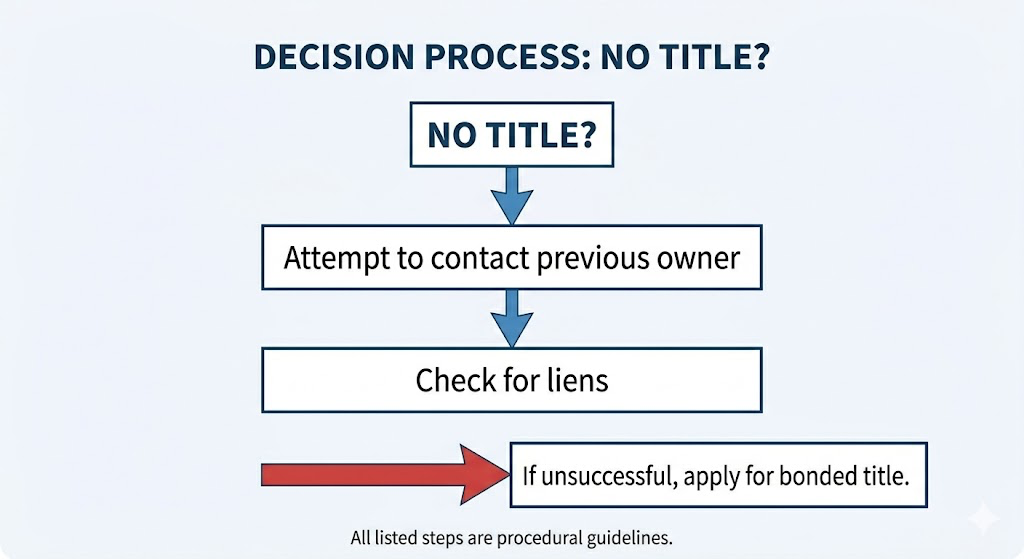
Important: You must make every reasonable attempt to obtain the original title before applying for a bonded title . Most states require you to document your efforts, such as letters to the previous owner or a lienholder search .
State-by-State Bonded Title Requirements
Bonded title laws vary significantly by state. Below are key requirements from several states. Always check with your specific state’s DMV.
Vermont
Vermont requires a bonded title for RVs and other vehicles when the original title is unavailable .
Required documents for Vermont:
- Title Bond form (VT-020) completed by your surety
- Vermont Registration, Tax, and Title form
- Verification of VIN (VT-010)
- Bill of sale or other ownership documentation
- Fees for registration, tax, and title
Submit to: Vermont Department of Motor Vehicles, 120 State Street, Montpelier, VT 05603
Texas
Texas has specific bonded title requirements under Transportation Code Section 501.053 .
Arizona
Arizona requires a bonded title when there is not enough documentation to prove ownership or if there are undisclosed liens .
| Requirement | Details |
|---|---|
| Bond amount | 1.5 × vehicle or mobile home value |
| Process steps | Vehicle inspection, applicant affidavit, owner/lienholder notification, purchase surety bond |
Iowa
Iowa has a detailed bonding process through the Department of Natural Resources for RVs, boats, and snowmobiles .
Required steps in Iowa:
- Submit Request Form for Bonded Title or Registration (Form 542-0855)
- Provide bill of sale and photos of the RV (front, back, side, VIN)
- DNR investigates (minimum 12 weeks)
- If approved, purchase surety bond
- Register through county recorder’s office
Illinois (for Mobile Homes)
Illinois treats mobile homes as motor vehicles for titling purposes .
States That Do Not Offer Bonded Titles
Some states do not offer bonded titles at all . These include:
- Delaware
- Kansas
- Kentucky
- Louisiana
- Ohio
- Oregon
- Pennsylvania
- Wyoming
If you live in one of these states, you may need to :
- Petition a court for a court order declaring you the legal owner
- Contact the previous owner to obtain a duplicate title
- Register the RV in another state first (e.g., South Dakota or Montana) then transfer back
Step-by-Step Process to Get a Bonded Title for Your RV
While steps vary by state, the general process follows this pattern:
Step 1: Check Eligibility and State Requirements
Contact your state’s DMV or equivalent agency to confirm that a bonded title is available for your RV . Ask about:
- Residency requirements
- Bond amount calculation (typically 1.5 × appraised value)
- Required documents
- Fees
Step 2: Attempt to Obtain the Original Title
Most states require you to make reasonable attempts to get the original title before allowing a bonded title . Document your efforts, including:
- Letters to the previous owner (keep copies)
- Lienholder searches
- Contacting the state where the RV was last titled
In Iowa, the DNR conducts an investigation that takes a minimum of 12 weeks . In Vermont, you must show letters from the issuing state that the title is unavailable .
Step 3: Get an Appraisal and VIN Inspection
Determine your RV’s current value using:
- J.D. Power (formerly NADA) guides
- Kelly Blue Book
- A licensed appraiser (for mobile homes in Illinois)
VIN inspection: Most states require a VIN verification by a licensed dealer, DMV officer, or certified inspector .
Step 4: Gather Required Documents
You will typically need:
Step 5: Purchase the Surety Bond
The bond amount is typically 1.5 times the RV’s appraised value .
| RV Appraised Value | Bond Amount Required | Premium Cost (Typical) |
|---|---|---|
| $4,000 | $6,000 | $100 |
| $10,000 | $15,000 | $100 – $225 |
| $15,000 | $22,500 | $225 – $337 |
| $20,000 | $30,000 | $300 – $450 |
- Bonds up to $6,000: Often a flat $100
- Bonds $6,001 – $50,000: Approximately $15-$20 per $1,000 of coverage
- Premiums typically range from 1-3% of the bond amount for qualified applicants
Credit check: Many states (like Vermont) do not require credit checks for title bonds under certain amounts .
How to Get a Bonded Title Bond for Your RV
The process follows four simple steps, and specialists like Swiftbonds have placed these bonds for RV owners nationwide, working with A.M. Best A-rated sureties. Here is how it works:
- Apply: Complete a surety bond application with your basic information and the bond amount required by your state (typically from your DMV’s Notice of Determination or appraisal).
- Quote: Within minutes or hours, the surety returns a premium quote based on your bond amount (credit check often not required for smaller bonds).
- Pay: You pay the premium via credit card, ACH, or wire transfer—typically $100 to $450 depending on your RV’s value.
- File: The surety issues the bond, and you file it with your state’s DMV along with your other documents.
Swiftbonds LLC
Voted 2025 Surety Bond Agency of the Year
4901 W. 136th Street
Leawood KS 66224
(913) 214-8344
https://swiftbonds.com/
Step 6: Submit Application to DMV
Submit your completed bond, application forms, supporting documents, and fees to your state’s DMV .
Timeline expectations:
- Vermont: Several weeks to process
- Iowa: Minimum 12 weeks for investigation
- Texas: 30-day waiting period for non-dealers (effective September 1, 2025)
Step 7: Receive Bonded Title and Wait Out the Bond Period
Once approved, you will receive a bonded title. The bond remains active for the required period—typically 3 years .
During this period:
- The bond protects any previous owner or lienholder with a valid claim
- You can register, insure, and use your RV normally
- You cannot sell the RV without transferring the bonded title
Step 8: Convert to Clear Title (After Bond Expires)
After the bond period expires with no claims, you can apply for a standard, clear title . In Vermont, the bonded title expires after 3 years and does not renew—you can then apply for a standard title . In Illinois, if no one claims the vehicle in 3 years, you get your bond back and the title becomes clear .
How Much Does a Bonded Title for an RV Cost?
Total costs typically include:
| Cost Component | Typical Amount |
|---|---|
| Surety bond premium | $100 – $450 |
| DMV application fee | $20 – $100 |
| VIN inspection fee | Varies (often $10-$25) |
| Appraisal fee (if needed) | Varies |
| Title and registration fees | $50 – $500 depending on state |
Total estimated cost: $200 – $800 for most RV owners, plus applicable sales tax.
Frequently Asked Questions
Q: Can I get a bonded title for an RV if I live in a state that doesn’t offer them?
Yes. You may need to register the RV in a state like South Dakota or Montana first, then transfer it back to your home state. Some owners also use a court order to establish ownership .
Q: How long does the bonded title process take?
It varies by state. Vermont takes several weeks. Iowa takes a minimum of 12 weeks. Texas has a 30-day waiting period under the new law .
Q: What happens if someone files a claim against my bonded title?
The surety investigates. If valid, the surety pays the claimant up to the bond amount. You must then reimburse the surety in full.
Q: Can I sell my RV with a bonded title?
Yes, but the bonded title transfers with the RV. The new owner will inherit the remaining bond period.
Q: Do I need a bonded title if I have a bill of sale?
In most states, a bill of sale alone is not sufficient to register an RV. You will need a bonded title or other legal proof of ownership .
Q: Can I get a bonded title with bad credit?
Yes. Many sureties offer title bonds with no credit check, especially for bond amounts under $50,000 .
5 Interesting Things About Bonded Titles for RVs Not in the Top 10 Sites
- South Dakota and Montana are popular workarounds for difficult states. If your home state makes bonded titles nearly impossible, many RV owners register their vehicle in South Dakota or Montana first (which have flexible rules), then transfer the registration back to their home state .
- The 30-day waiting period in Texas is a brand new law. Under SB 2245, effective September 1, 2025, Texas now requires a 30-day waiting period before issuing a bonded title to non-dealers—and anyone can object during that period .
- Some states hold your bond for the full period even if you sell the RV. In Vermont, the bonded title expires after 3 years regardless of ownership changes. In Illinois, you get your bond back after 3 years if no claims are made .
- Mobile homes are treated as motor vehicles for bonded titles in Illinois. Under Illinois law, mobile homes follow the same bonded title process as cars and RVs—including the 1.5× appraisal bond requirement .
- Iowa requires photos of your RV from five different angles. As part of the bonding process, Iowa DNR requires photos of the front, back, one side, the registration number, and the VIN/HIN . This helps verify the RV’s identity and condition.
Conclusion
A bonded title is a legal document that proves ownership of an RV when the original title is missing, lost, or cannot be transferred. The process requires purchasing a surety bond typically set at 1.5 times the RV’s appraised value. The bond protects previous owners and lienholders for a set period—usually three years—after which you can convert to a standard clear title.
State requirements vary significantly. Vermont requires residency and a VIN inspection. Texas has a new 30-day waiting period. Iowa conducts a 12-week investigation. Some states (Delaware, Kansas, Kentucky, Louisiana, Ohio, Oregon, Pennsylvania, Wyoming) do not offer bonded titles at all .
Before starting, check your specific state’s DMV requirements. Gather your bill of sale, identification, and any documentation of your attempts to obtain the original title. Purchase your surety bond from a licensed provider—premiums start at $100 for lower-value RVs. File your application and wait out the bond period. After three years with no claims, you will receive a clear title and full legal ownership.
Leave a Reply