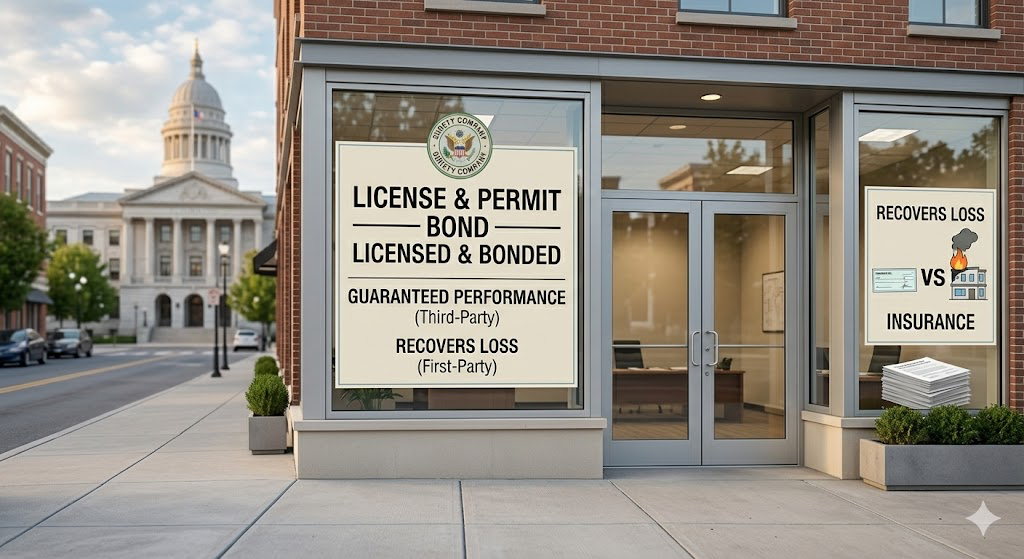
You want to open a business. You have the capital, the location, and the customers waiting. But before you can legally operate, your state or city requires one more thing: a license and permit bond. Without it, you cannot get your business license. This guide explains exactly what a license and permit bond is, who needs one, and how to get bonded.
The Simple Definition
A license and permit bond is a type of surety bond required by a government agency—federal, state, or local—before a business can obtain a license or permit to operate in a regulated industry .
The bond guarantees that the business will follow all applicable laws, regulations, and codes governing that industry . If the business violates those rules and causes financial harm to customers or the government, the bond provides a source of compensation .
The bond is a three-party agreement between:
- Principal: The business owner or licensee who needs the bond
- Obligee: The government agency requiring the bond (city, state, or federal)
- Surety: The company that issues the bond and backs the guarantee
What a License and Permit Bond Guarantees
License and permit bonds serve a public protection function. They guarantee that the bonded business will :
- Comply with all applicable laws, ordinances, and regulations
- Perform all written agreements with customers
- Correctly and accurately account for all funds received from customers
- Conduct business ethically and without fraud or misrepresentation
- Pay required taxes and fees to the government
If a business violates these obligations, the bond provides a financial remedy. Customers who are harmed can file a claim against the bond to recover damages . The government agency can also file a claim for regulatory violations.
Who Needs a License and Permit Bond?
License and permit bonds are required for a wide range of regulated professions. The specific requirements vary by state and local jurisdiction .
| Industry | Typical Bond Amount | Common Name |
|---|---|---|
| Contractors (general and specialty) | $5,000 – $25,000 | Contractor license bond |
| Auto dealers (new and used) | $10,000 – $50,000 | Auto dealer bond |
| Mortgage brokers and lenders | $10,000 – $50,000 | Mortgage broker bond |
| Money transmitters | $50,000 – $500,000 | Money transmitter bond |
| Collection agencies | $5,000 – $25,000 | Collection agency bond |
| Health clubs and gyms | $10,000 – $50,000 | Health club bond |
| Notaries public | $500 – $10,000 | Notary bond |
| Freight brokers | $75,000 | BMC-84 freight broker bond |
| Motor vehicle title lenders | $50,000 per location | Title lender bond |
| Explosives users (mining) | $100,000 | Explosives permit bond |
How License and Permit Bonds Differ from Other Bonds
| Feature | License & Permit Bond | Performance Bond |
|---|---|---|
| When required | Before obtaining a business license | Before starting a specific construction project |
| What it guarantees | Ongoing compliance with laws and regulations | Completion of a specific contract |
| Duration | Continuous (renewed annually) | Until project completion |
| Obligee | Government agency (city, state, federal) | Project owner |
| Claimant | Government or harmed consumers | Project owner |
License and permit bonds are considered a type of commercial bond . Unlike contract bonds (bid, performance, payment), which are tied to specific projects, license and permit bonds are tied to the ongoing operation of a business.
How Much Does a License and Permit Bond Cost?
The premium you pay for a license and permit bond is a percentage of the required bond amount. Because these bonds are considered lower risk than performance bonds, they are generally affordable and easy to qualify for .
| Bond Amount | Good Credit (1-3%) | Average Credit (4-7%) | Challenged Credit (8-15%) |
|---|---|---|---|
| $5,000 | $50 – $150 | $200 – $350 | $400 – $750 |
| $10,000 | $100 – $300 | $400 – $700 | $800 – $1,500 |
| $25,000 | $250 – $750 | $1,000 – $1,750 | $2,000 – $3,750 |
| $50,000 | $500 – $1,500 | $2,000 – $3,500 | $4,000 – $7,500 |
| $100,000 | $1,000 – $3,000 | $4,000 – $7,000 | $8,000 – $15,000 |
Factors affecting your bond cost include:
- Personal credit score (primary factor)
- Business financial strength
- Years in business and industry experience
- Bond amount required by the state or city
State and Local Variations
License and permit bond requirements vary significantly by jurisdiction. Some key examples:
Illinois: The Contractor Unified License and Permit Bond Act allows counties and municipalities to require a “unified license and permit bond” that combines what are commonly known as a license bond and a permit bond into a single document .
Florida: Explosives users in construction materials mining must post a bond of at least $100,000 as a prerequisite to obtaining or renewing a user license .
Virginia: Motor vehicle title lenders must file a $50,000 bond per location (up to $500,000 total) conditioned upon the licensee performing all written agreements with borrowers and conducting business in conformity with state law .
Ogden City, Utah: Contractors excavating deeper than 12 inches in the right-of-way must carry a $25,000 license and permit bond. Those doing only paving and flatwork can carry a $5,000 bond .
Wheat Ridge, Colorado: The city requires a $10,000 license or permit bond, with a two-year warranty period from the date of work completion for any work performed under the bond .

How a License and Permit Bond Works in Practice
Here is a step-by-step example of how a license and permit bond functions:
Step 1: The Requirement
A city requires all auto dealers to post a $25,000 license bond before issuing a dealer license.
Step 2: The Bond Purchase
The auto dealer purchases the bond from a surety company, paying an annual premium (e.g., $500 for a qualified applicant).
Step 3: The Violation
The dealer sells a used car but fails to disclose known major engine damage, violating state consumer protection laws.
Step 4: The Claim
The defrauded customer files a claim against the bond, seeking compensation for the undisclosed damage.
Step 5: The Payment
The surety investigates. If the claim is valid, the surety pays the customer up to the bond amount.
Step 6: The Reimbursement
The dealer must reimburse the surety for the full amount paid, plus legal fees and costs.
What the Bond Covers
| Covered | Not Covered |
|---|---|
| Fraud or misrepresentation to customers | General business debts |
| Violation of state or local regulations | Employee injuries (workers’ comp) |
| Failure to perform written agreements | Property damage (general liability) |
| Improper accounting of customer funds | Environmental cleanup costs |
| Violation of license conditions |
What Happens When a Bond Is Cancelled
Most license and permit bonds are continuous bonds that remain in effect until cancelled . The bond typically includes a cancellation provision requiring the surety to provide written notice to the obligee—often 30 days—before liability terminates as to subsequent acts or omissions of the principal .
If your bond is cancelled, your business license may be suspended or revoked. You must obtain a replacement bond immediately and file it with the regulating agency.
How to Get a License and Permit Bond
The process follows four simple steps, and specialists like Swiftbonds have placed these bonds for businesses nationwide, working with A.M. Best A-rated sureties. Here is how it works:
- Apply: Complete a surety bond application with your business information and credit details. Many smaller license bonds can be issued instantly without a credit check.
- Quote: Within hours, the surety returns a premium quote based on your credit profile and the required bond amount.
- Pay: You pay the annual premium via credit card, ACH, or wire transfer.
- File: The surety issues the bond, and you file it with the city, state, or federal agency as part of your license application.
Swiftbonds LLC
Voted 2025 Surety Bond Agency of the Year
4901 W. 136th Street
Leawood KS 66224
(913) 214-8344
https://swiftbonds.com/
Frequently Asked Questions
Q: Is a license bond the same as a permit bond?
They are closely related. Some jurisdictions require separate bonds, while others (like Illinois) allow a “unified license and permit bond” that serves both purposes . Both are types of surety bonds guaranteeing compliance with regulations.
Q: Do I need a license and permit bond if I already have insurance?
Yes. Insurance protects you from financial losses. A bond protects the government and consumers from your regulatory violations. They serve different purposes and are not interchangeable .
Q: How long does a license and permit bond last?
Most are continuous bonds that remain in effect until cancelled . You pay an annual premium to keep the bond active. If you stop paying, the surety will cancel the bond, and your license may be suspended.
Q: Can I get a license bond with bad credit?
Yes. Many sureties offer bad credit programs for license and permit bonds because these bonds are generally lower risk. However, you will pay a higher premium—typically 8-15% of the bond amount.
Q: Who pays for the bond?
The business owner (principal) pays the premium. This is a cost of doing business in regulated industries.
Q: What happens if a claim is filed against my bond?
The surety investigates the claim. If valid, the surety pays the claimant (customer or government) up to the bond amount. You must then reimburse the surety in full.
Q: Do all states require license bonds for contractors?
Most states require contractors to be licensed and bonded, but requirements vary significantly by state and by trade. Check with your state’s licensing board.
5 Interesting Things About License and Permit Bonds Not in the Top 10 Sites
- Some states allow a single bond to cover multiple permits. Illinois law permits a “unified license and permit bond” that combines separate bonding requirements into one document, simplifying compliance for contractors who work across multiple jurisdictions .
- The bond amount can be staggering for high-risk industries. Florida requires explosives users in mining to post a $100,000 bond—not for performance, but simply to obtain a license to use explosives in construction materials mining .
- Bonds protect consumers before harm occurs. Unlike insurance that pays after a loss, a license bond acts as a deterrent. The requirement itself discourages bad actors from entering regulated industries because they know they will be financially liable for violations.
- Cities can set their own bond amounts. While states often set bond amounts by statute, many cities have home rule authority to require additional bonds. Ogden City requires a $25,000 bond for deep excavation—a local requirement separate from any state bond .
- The bond form is often standardized by the obligee. Unlike many insurance policies that are drafted by the insurer, license and permit bond forms are typically prescribed by the government agency requiring the bond. Wheat Ridge, Colorado provides its own bond form that contractors must use .
Conclusion
A license and permit bond is a type of surety bond required by government agencies before a business can obtain a license or permit to operate in a regulated industry . The bond guarantees that the business will comply with all applicable laws, regulations, and codes, and provides financial protection to consumers and the government if violations occur .
These bonds are required for a wide range of professions, including contractors, auto dealers, mortgage brokers, money transmitters, collection agencies, health clubs, notaries, freight brokers, and title lenders . Requirements vary significantly by state and local jurisdiction, so always check with your specific licensing authority.
Premiums typically range from 1% to 15% of the bond amount, depending on credit . Most license and permit bonds are continuous and must be renewed annually to keep your license active . Unlike insurance, if a claim is paid against your bond, you must reimburse the surety in full.
Before opening any regulated business, research your bonding requirements. The bond is not optional—it is a condition of doing business legally.
Leave a Reply