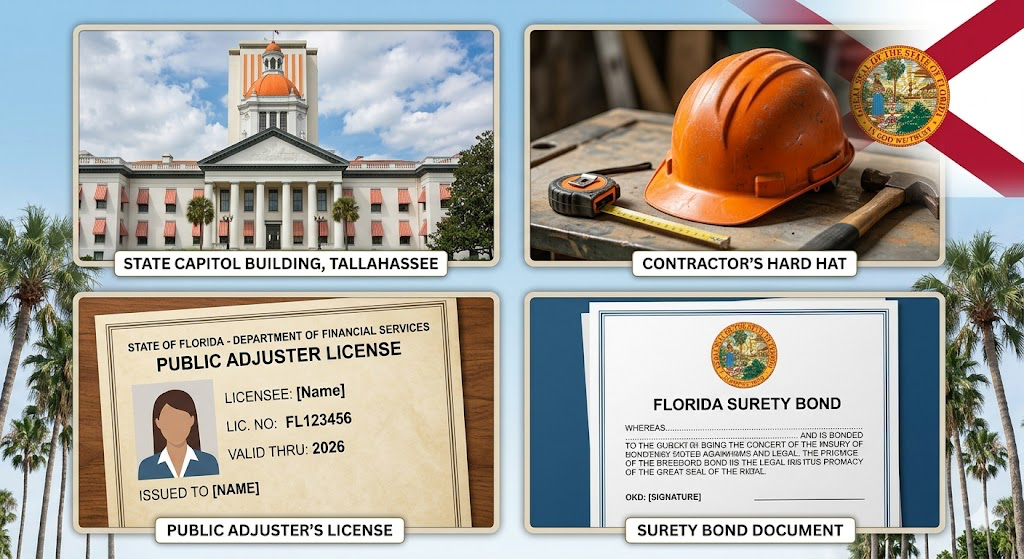
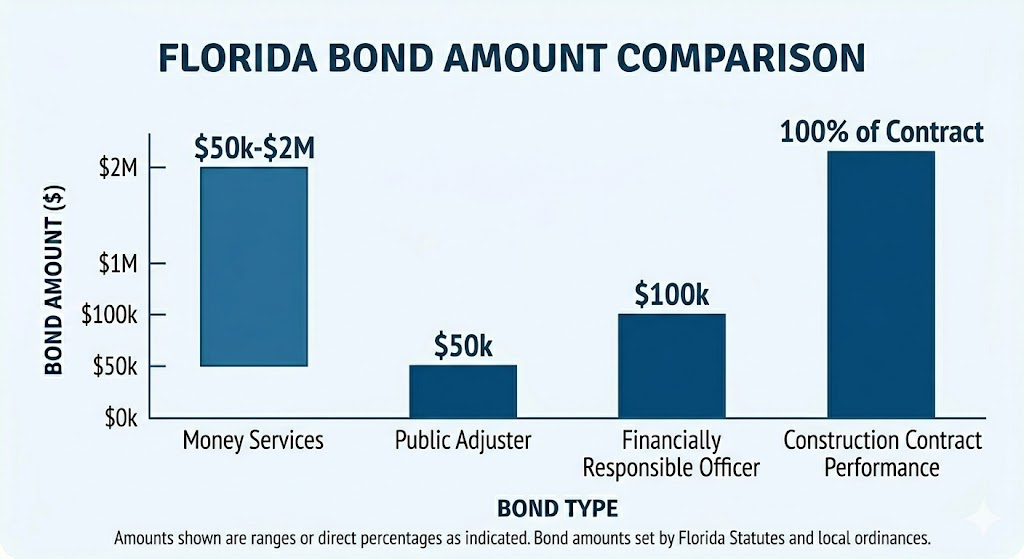
You want to do business in Florida. Whether you are a contractor, a public adjuster, a money transmitter, or a construction company financial officer, one question comes up: do you need a surety bond? The answer is yes for many professions—and the requirements are strict. Money service businesses need bonds from $50,000 to $2 million. Public adjusters need $50,000. Construction contracts over $250,000 require performance and payment bonds. And sureties must be Treasury-listed and A.M. Best A-rated. This guide covers everything you need to know about purchasing surety bonds in Florida—the requirements, the costs, the statutes, and exactly how to get bonded.
What Is a Florida Surety Bond?
A surety bond is a three-party agreement that guarantees a business will comply with state laws and fulfill its obligations to customers and the state . If the business fails to perform—through fraud, code violations, or non-payment—the bond provides financial compensation to the harmed party.
The three parties are:
- Principal: The business or individual who needs the bond
- Obligee: The Florida state agency or court requiring the bond
- Surety: The company that issues the bond and backs the guarantee
If a claim is filed against the bond and found valid, the surety pays the claimant up to the bond amount. The business must then reimburse the surety in full .
Florida Money Services Business Bond
Under Florida Statute 560.209, money service businesses must provide a corporate surety bond before the Office of Financial Regulation may issue a license .
| Requirement | Details |
|---|---|
| Minimum bond amount | $50,000 |
| Maximum bond amount | $2 million |
| Net worth requirement | $100,000 minimum (plus $10,000 per additional location, up to $2 million) |
| Bond runs to | State of Florida for benefit of claimants |
| Claimants may sue directly | Yes, on the bond |
| Cancellation notice | 30 days written notice to the office by registered mail |
Bond amount determination: The Office of Financial Regulation sets the bond amount by rule, with allowances for the licensee’s financial condition, number of locations, and anticipated volume .
Post-cancellation requirements: The bond and collateral deposit shall remain in place for 5 years after the licensee ceases licensed operations in Florida .
If bond is reduced by claims: If the principal sum of the bond is reduced by payments, the licensee must furnish a new or additional bond to restore the required amount, or furnish an endorsement reinstating the bond.
Alternative to Bond: Collateral Deposit
In lieu of a corporate surety bond, an applicant may deposit collateral cash or securities with a federally insured financial institution . Acceptable items include:
- Cash
- Interest-bearing stocks and bonds of the United States
- Notes, debentures, or other obligations of the United States
- Obligations of the State of Florida
The collateral deposit must be in an aggregate amount at least equal to the required bond amount. The principal is entitled to receive interest and dividends .
Florida Public Adjuster Bond
Public adjusters in Florida must obtain a surety bond from the Florida Department of Financial Services before receiving a license .
| Requirement | Details |
|---|---|
| Bond amount | $50,000 |
| Filing location | Florida Department of Financial Services |
| Credit check | Programs available for credit issues |
- Obtain a business license application from the Florida Department of Financial Services
- Apply for your surety bond
- Send your Florida license application and signed bond to the department
Florida Construction Performance and Payment Bonds
For public construction contracts in Florida, surety bonds are required by statute.
| Contract Value | Bond Required | Bond Amount |
|---|---|---|
| Over $150,000 | Bid Bond | Not exceeding 5% of preliminary estimate |
| Over $250,000 | Performance Bond & Payment Bond | 100% of awarded contract price |
Surety qualification requirements for public contracts [citation]:
- Surety must be authorized to do business in Florida
- Surety must be named in U.S. Treasury Circular 570
- Surety must have A.M. Best rating of A VIII or better
- Bonds signed by an agent must be accompanied by a certified copy of authority to act
Alternative for multiyear maintenance contracts: The City may allow for incremental annual contract bonds that cumulatively total the full multiyear contract price .
Subcontractor bonds: On subcontracts where the bid exceeds $300,000, the construction manager may request that the subcontractor provide a 100% performance bond and payment bond from a surety authorized to do business in Florida .
Florida Financially Responsible Officer Bond
Financially responsible officers (FROs) for construction companies in Florida must file a surety bond with the Florida Department of Business and Professional Regulation (DBPR) .
| Requirement | Details |
|---|---|
| Bond amount | $100,000 |
| Premium (no credit check) | $1,000 |
| Term | 1 year |
- Make all payments due to the State Treasurer
- Accurately maintain books and records
- Make reports per DBPR regulations and federal laws
Florida Court and Probate Bonds
Florida courts and probate proceedings frequently require surety bonds .
Appeal bonds guarantee that if the appeal is unsuccessful, the judgment and associated costs will be paid. Florida courts may require the bond amount to be 125% of the judgment to cover potential interest and costs.
Probate and fiduciary bonds protect the interests of heirs, beneficiaries, and individuals under guardianship. These bonds ensure that executors, administrators, and guardians act responsibly and follow state law .
Florida License and Permit Bonds
Certain Florida businesses and professionals must post license or permit bonds before they can operate legally . These bonds guarantee compliance with state laws and protect consumers from financial loss caused by misconduct or non-compliance.
Common Florida license bonds include:
- Contractor license bonds
- Auto dealer bonds
- Mortgage broker bonds
- Collection agency bonds
- Notary bonds
How to Purchase a Surety Bond in Florida
The process follows four simple steps, and specialists like Swiftbonds have placed these bonds for Florida businesses, working with A.M. Best A-rated, Treasury-listed sureties. Here is how it works:
- Apply: Complete a surety bond application with your business information, credit details, and the specific bond type and amount required by your Florida agency.
- Quote: Within hours (or instantly for some bonds), the surety returns a premium quote based on your credit profile and the required bond amount. Some bonds, like the $100,000 Financially Responsible Officer bond, are available with no credit check .
- Pay: You pay the premium via credit card, ACH, or wire transfer.
- File: The surety issues the bond, and you file it with the relevant Florida agency as required.
Swiftbonds LLC
2025 Surety Bond Technology Provider of the Year
4901 W. 136th Street
Leawood KS 66224
(913) 214-8344
https://swiftbonds.com/
Surety Qualification Requirements in Florida
When a Florida contract or statute requires a surety bond, the surety company itself must be qualified. For public construction contracts, the requirements are strict :
- Surety must be authorized to do business in the State of Florida
- Surety must be named in the current list of “Companies Holding Certificates of Authority as Acceptable Sureties on Federal Bonds” as published in Circular 570 by the U.S. Treasury Department
- Surety must have an A.M. Best rating of A VIII or better
- Bonds signed by an agent must be accompanied by a certified copy of authority to act
For private contracts, the surety must still be authorized to do business in Florida and rated A or better by Best’s Key Guide .
How Much Do Florida Surety Bonds Cost?
The cost of a surety bond is the premium you pay to the surety company—a small percentage of the bond amount.
Factors affecting your premium:
- Personal credit score (primary factor)
- Bond amount required
- Business financial history
- Years in business
Even if you have credit issues, you can still get bonded—many sureties have exclusive programs for applicants with credit challenges .
Frequently Asked Questions
Q: How much is a money service business bond in Florida?
The bond amount ranges from $50,000 to $2,000,000, set by the Office of Financial Regulation based on financial condition, number of locations, and anticipated volume .
Q: Do construction contracts in Florida require performance bonds?
Yes. For public construction contracts over $250,000, both a performance bond and a payment bond are required at 100% of the contract price .
Q: What surety rating does Florida require for public contracts?
The surety must have an A.M. Best rating of A VIII or better and be listed on U.S. Treasury Circular 570 .
Q: Can I get a surety bond with bad credit in Florida?
Yes. Many sureties offer programs for applicants with credit challenges, including exclusive programs that allow them to write these bonds even if you have credit issues .
Q: What happens if a claim is filed against my bond?
The surety investigates. If valid, the surety pays the claimant up to the bond amount. You must then reimburse the surety in full.
Q: How long does a Florida surety bond last?
Most license bonds are valid for one year and must be renewed annually. Money service business bonds remain in place for 5 years after the licensee ceases licensed operations .
Q: Can I use a cash deposit instead of a surety bond in Florida?
Yes. Under Florida Statute 560.209(4), you may deposit collateral cash or securities with a federally insured financial institution in lieu of a bond .
Q: Where do I file my Florida surety bond?
Public adjuster bonds are filed with the Florida Department of Financial Services. Money service business bonds are filed with the Office of Financial Regulation. Construction bonds are filed with the contracting agency. Check with your specific licensing agency.
5 Interesting Things About Florida Surety Bonds Not in the Top 10 Sites
- Florida requires a 5-year tail on money service bonds. Under §560.209(6), the bond and collateral deposit must remain in place for 5 years after the licensee ceases licensed operations in Florida—far longer than most states’ requirements .
- The surety must notify the state within 10 days of paying any claim. Under §560.209(3)(d), the corporate surety must, within 10 days after it pays any claim, give written notice to the office by registered mail with details sufficient to identify the claimant and the claim paid .
- Collateral deposit interest goes to the depositor, not the state. Unlike some states where deposited funds earn interest for the state, Florida allows the depositor to receive any interest and dividends on collateral deposits .
- Florida’s bid bond threshold ($150,000) and performance bond threshold ($250,000) are different. This is unusual—most states use the same threshold for both. Florida requires a bid bond at $150,000 but a performance bond only at $250,000 .
- Subcontractors may need bonds on contracts over $300,000. Under many Florida construction contracts, the construction manager may require subcontractors to provide 100% performance and payment bonds when the subcontract exceeds $300,000 .
Conclusion
Florida requires surety bonds for many professions, including money services businesses ($50,000 to $2,000,000), public adjusters ($50,000), construction contracts over $250,000 (100% performance and payment bonds), and financially responsible officers ($100,000). Courts also require appeal bonds, probate bonds, and other fiduciary bonds .
The cost of a Florida surety bond is a small percentage of the bond amount—typically 1-5% for applicants with good credit. The $100,000 Financially Responsible Officer bond is available for a flat $1,000 with no credit check .
For public construction contracts, the surety must be Treasury-listed (Circular 570) and A.M. Best rated A VIII or better . Money service businesses may deposit collateral cash or securities in lieu of a bond, but the bond must remain in place for 5 years after ceasing operations .
Before applying for any Florida surety bond, confirm the specific requirement with the relevant agency: the Department of Financial Services for public adjusters, the Office of Financial Regulation for money service businesses, or the contracting agency for construction bonds. The bond is not optional for most licensed professions—it is a condition of doing business legally in Florida.